

How timber reduces CO₂ emissions in multi-storey residential buildings
WOOD AS
A FACTOR IN CLIMATE PROTECTION
The building sector faces a key challenge: how can we meet the growing demand for housing while building in a more resource-efficient way?
In addition to energy efficiency during a building’s operational life, attention is increasingly turning to the construction phase – that is, the emissions generated by raw material extraction, production and construction.
A recent study by the Vienna University of Technology shows that timber and timber-hybrid constructions offer considerable potential for CO₂ reduction in multi-storey residential buildings. Through the increased use of timber, an average 204 kg of CO₂ equivalents per square metre of gross floor area can be saved during the construction phase. Compared with similar reinforced concrete structures, this corresponds to a reduction in greenhouse gas emissions of up to 50 per cent.

Why wood makes a difference
The environmental benefits of timber stem primarily from two factors:
- Timber replaces high-emission building materials: Concrete and steel are important building materials, but they generate high CO₂ emissions even during their manufacture. If load-bearing components such as walls, ceilings or roof structures are replaced by timber or timber-hybrid solutions, these emissions can be significantly reduced. At the same time, timber meets the highest standards for load-bearing capacity, fire safety, sound insulation and durability.
- Wood stores carbon: As it grows, a tree absorbs CO₂ from the atmosphere and stores the carbon in its wood. When wood is used in buildings over the long term, this carbon store is preserved throughout the building’s entire service life. Wooden buildings therefore make an active contribution to climate protection.
Structural frames and floor slabs as key levers
There is particularly great potential for components that require a large amount of material – especially load-bearing walls and floor slabs. This is where timber can really showcase its advantages:
Lower fossil fuel emissions:
Wood and wood-hybrid structures produce significantly lower fossil fuel emissions during the manufacturing phase than comparable mineral-based reinforced concrete structures.
Lower kerb weight:
The high load-bearing capacity combined with low weight enables efficient designs, reduces transport costs and opens up new possibilities in planning.
High
level of prefabrication:
Digital planning, BIM processes and precision manufacturing at the factory ensure short assembly times, high quality and better predictability of construction processes.
Flexibility throughout the life cycle:
Modern timber structures can be designed in such a way that buildings remain adaptable and usable in the long term.
Multi-storey timber construction projects in practice:
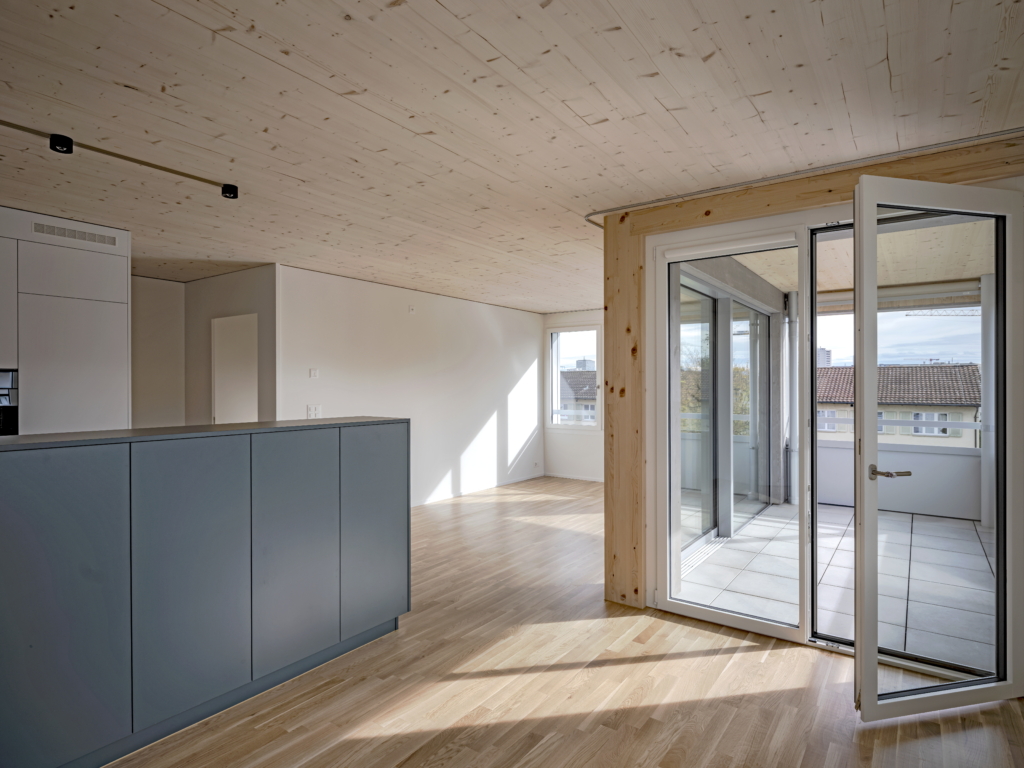
The benefits of modern timber construction methods are already evident in our numerous projects.
Examples:
Test


Would you like to harness the potential of modern timber construction for your project?